 0800 118 2500
 24th May 2023
 5 min read
How to size a submersible pump
The right size submersible pump must deliver the required flow rate at your system’s total dynamic head. Outlet diameter and motor power alone do not tell you whether a pump can do the job. Start with the duty point, then check the liquid, solids, installation depth and available power supply.
- Work out the flow rate. Divide the volume to be moved by the time available. Allow for incoming water while the pump is running.
- Calculate the head. Include the difference between the source water level and discharge level, pipe and fitting losses at the required flow, and any pressure needed at discharge.
- Match both values on the pump curve. A quoted maximum flow and maximum head are different ends of the curve; they are not delivered together.
- Check the application. Confirm solids size, abrasiveness, liquid properties, allowable immersion depth and the manufacturer’s operating limits.
- Check the installation. Confirm the discharge pipework, electrical supply, controls and starting requirements for the selected model.
Worked example: flow rate and head
Suppose you need to remove 12,000 litres in 30 minutes, with no water entering during that time. The required flow is 12,000 ÷ 30 = 400 L/min, equivalent to 24 m³/h.
If the discharge is 8 m above the source water level and the calculated pipe and fitting losses at 400 L/min are 4 m, an open-discharge system needs 12 m total dynamic head. Look for a pump curve that supplies 400 L/min at 12 m head. A pump labelled “maximum head 12 m” would not meet that duty, because maximum head is normally at zero flow. These are illustrative figures; calculate the losses for your actual pipe length, diameter and fittings.
For a wider comparison of pump types, read our pump selection guide. The application notes below explain the other factors that affect submersible pump sizing.
Dewatering & Flood Control
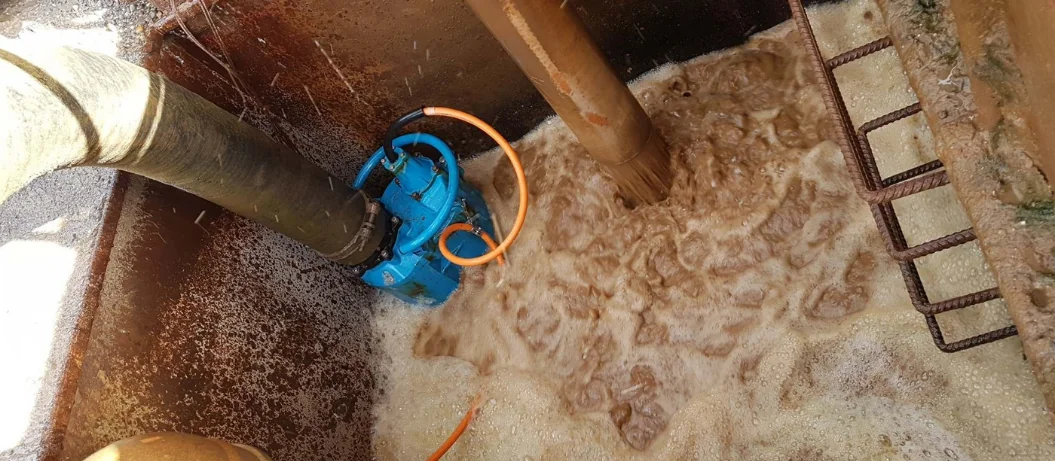
The main aim of submersibles for flood or dewatering purposes is to move a high volume of water a sufficient distance so it discharges safely off-site. A good dewatering pump has a reliable, powerful motor with a larger diameter discharge hose to provide a good flow-rate, plus a quick and efficient on/off control. An important consideration in pumping run-off flood water is that its likely to be contaminated with solids; possibly of unknown size and concentration. To achieve the same output, pumps made for ‘dirty-water’ require a larger motor, plus a gap between the volute chamber and impeller to allow for pebbles, sand, silt, and the like. On the Audex “AW” range of submersible pumps, an agitator is attached to the shaft to minimise the risk of sand clogging up the pump.
Process Water & Irrigation Pumps
Pumps for delivering water for irrigation or factory processes need to deliver a consistent, measured flow, often with a certain pressure needed at the delivery end. The balance of pressure and flow rate is achieved through the motor’s power output and the discharge pipe’s diameter. Check the diameter of the inlet on the machine or irrigator used, as a reduction in piping diameter will need factoring in to the size of pump needed.
Electric pumps fitted with a variable frequency drive (VFD) are good for controlling the speed of the motor to fine-tune the flow and pressure requirements to match the system. However, you should ask your pump supplier for the pump curve chart, which will tell you if it will accommodate your flow and head requirements.
Well Pump
Often required to pump water a high vertical distance, head pressure is often more important than flow volume. Well pumps are often designed to fit inside narrow-diameter boreholes. The pressure available is controlled by the motor power in relation to the pipe size. A powerful motor, slim body, and narrow outlet makes a good well or borehole pump configuration.
Choosing Pump Size For Flow Rate
Depending on region and pump size category, flow-rate is measured in gallons per minute/hour, litres per minute/hour, or sometimes cubic metres per hour (m3/hr) which is the volume that the pump system is capable of moving in a given time. When choosing what size pump you need, consider the maximum peak amount of water that needs to be moved per minute or hour. In the case of dewatering, this might be the maximum rainfall or groundwater seepage within the site’s water catchment area, whilst a processing plant might require delivery of a set volume per minute. A pump’s outlet (and pipe diameter) sets the maximum flow rate to a large degree. For example, the Audex 20hp motor driving a 4” pipe system gives a maximum flow of 1,400 l/min. Compare this to the same pump with an outlet twice the size at 8”, whose maximum flow rate is over four times that at 6200 l/min, albeit with less head pressure capacity.
Choosing Pump Size For Head Height
What is the vertical distance that the pump needs to lift the water? This elevation difference is measured from the source to the final discharge height, and to get the total dynamic head requirement we need to factor in resistance from friction caused by the pipe lining, bends and valves. Furthermore, if a specified pressure is needed at discharge, then this is added in.
So, the pump supplier might be asked for a pump size that can produce 4 bar of pressure at 35m head height. By specifying the flow volume, head height, and discharge pressure (if significant), the pump designer can configure the correctly sized pump and associated pipework. Pump motor being equal, a high-head pump will often have a narrower outlet/discharge pipe than one designed for high-flow/low head.
The Importance Of Pump Size
Going with a pump that is under-sized or oversized can lead to premature wear and failure, or wasted energy and purchasing costs. Every pump needs to have an adequate supply of fluid – known as Net Positive Suction Head available (NPSHa) whenever it’s running, to avoid burn-out and cavitation damage, whilst a pump that is straining to handle the system’s demands will fail all too soon.
Head Height Vs. Flow Volume
For centrifugal submersible pumps, flow generally falls as the head requirement rises. Use the manufacturer’s curve for the selected model, speed and impeller to check the actual duty point. The best efficiency point (BEP) is the point of highest efficiency shown on that curve; do not assume it is halfway between maximum flow and maximum head. Select within the manufacturer’s recommended operating range, preferably near BEP, and assess the expected range of system conditions. Any allowance for wear or future demand should be calculated rather than added as a blanket oversizing margin.
Maximum Submerged Depth
Something to be mindful of with submersible pumps is that they are built to withstand the water-pressure of up to a certain depth. In the case of Audex submersibles, these heavy-duty industrial pumps are rated water-proof for immersion at depths of 25 – 30m depending on model size. Other pumps, such as those designed for clean-water boreholes might have a greater immersion depth, whilst domestic model pumps are only suitable for shallow submersion. Suspending a submersible pump by chains (ideally from a floating pontoon), can overcome the risk of over-submerging a pump and this also keeps it clear of dredging up settled solids.
The Size Of The Pump, Vs The Size Of The Solids
Whilst clean water submersibles are designed with narrower tolerances to increase efficiency, submersibles for pumping slurry and solids-laden water need to have wider gaps between the moving parts. Larger motors and abrasive-resistant materials are also used on heavy-duty submersibles, like Audex pumps.
What Is The Power Supply Available?
The different sizes of submersible pumps come in various power ratings, measured in horsepower (HP) or kilowatts (kW), and are made for running on either low voltage 110v (typically used on construction sites), 240v, or three-phase 400v (380v -415v). The higher the kW, the greater the motor’s ability to generate pressure and flow rate, for example, the super-capacity 55kW submersible pump from Audex delivers 73HP which can lift 16,000 L/min up to 7m height, or a couple of thousand litres per minute up to 35m height.
What If Power Isn’t Available For The Size Of Pump I Need?
As most submersible pumps are electrically driven, generators are used to power them where off-grid use is required, or if it’s a 3-phase pump and only single-phase power is available. Bear in mind when sizing your generator that the start-up power draw will be significantly higher than the stated rating (approximately 6 times when starting DOL – direct on line). This spike can be reduced by installing a soft-start, or better still, an inverter. Audex highly recommends using a soft-start or invertor on any pump over 18.5 kW
The Audex Range Of Submersible Pumps
Audex are chosen for their robust design and materials that last longer than standard submersibles, pumping abrasive fluids and slurries in the minerals, metals, waste and recycling industries.
The maximum head and maximum flow figures below are separate limits, not a combined duty point. Check the current model data sheet and pump curve before selection.
| Audex Pump outlet (pipe) size: | Motor power (kW) | HP | Max head height (m) | Max flow-rate (L/min) | Max flow-rate (m³/h) | Anti-silt clogging agitator? |
| 2” (50mm) | 0.4 | 0.55 | 12 | 208 | 12.5 | Yes |
| 1.5 | 2 | 22 | 450 | 27 | ||
| 1.5 | 2 | 20 | 500 | 30 | Yes | |
| 2.2 | 3 | 26 | 550 | 33 | ||
| 2.2 | 3 | 25 | 500 | 30 | ||
| 3.7 | 5 | 32 | 550 | 33 | ||
| 3” (75mm) | 0.75 | 1 | 16 | 30 | 18 | Yes |
| 2.2 | 3 | 19 | 920 | 55 | ||
| 3.7 | 5 | 34 | 1000 | 60 | Yes | |
| 4 | 5.5 | 14 | 1650 | 99 | Yes | |
| 5.5 | 7.5 | 34 | 1250 | 75 | ||
| 3.7 | 5 | 28 | 833 | 50 | ||
| 4” (100mm) | 3.7 | 5 | 18.5 | 1500 | 90 | |
| 3.7 | 5 | 18 | 1500 | 90 | Yes | |
| 5.5 | 7.5 | 23 | 1750 | 105 | ||
| 6 | 8 | 17 | 2500 | 150 | Yes | |
| 7.5 | 10 | 40 | 1400 | 84 | ||
| 9 | 12 | 21.5 | 3200 | 192 | Yes | |
| 11 | 15 | 48 | 1400 | 84 | ||
| 15 | 20 | 56 | 1400 | 84 | ||
| 22 | 30 | 68 | 2166 | 130 | ||
| 30 | 40 | 78 | 2833 | 170 | ||
| 6” (150mm) | 7.5 | 10 | 31 | 2083 | 125 | |
| 9 | 12 | 21.5 | 3200 | 192 | Yes | |
| 11 | 15 | 32 | 2450 | 147 | ||
| 11 | 15 | 23 | 3900 | 234 | Yes | |
| 15 | 20 | 40 | 2600 | 156 | ||
| 22 | 30 | 50 | 3333 | 210 | ||
| 37 | 50 | 83 | 3666 | 220 | ||
| 45 | 60 | 90 | 3666 | 220 | ||
| 55 | 75 | 105 | 3200 | 192 | ||
| 75 | 100 | 130 | 3300 | 198 | ||
| 90 | 121 | 150 | 2500 | 150 | ||
| 8” (200mm) | 15 | 20 | 23 | 6200 | 372 | Yes |
| 22 | 30 | 32 | 6000 | 360 | Yes | |
| 30 | 40 | 37 | 6500 | 390 | Yes | |
| 37 | 50 | 48 | 5500 | 330 | ||
| 37 | 50 | 42 | 6500 | 390 | Yes | |
| 45 | 60 | 53 | 6200 | 372 | ||
| 55 | 74 | 65 | 6500 | 390 | ||
| 75 | 100 | 70 | 6800 | 408 | ||
| 90 | 121 | 90 | 6000 | 360 | ||
| 110 | 148 | 103 | 6500 | 390 | ||
| 10” (254mm) | 55 | 74 | 35 | 16000 | 960 |
Hopefully this guide has answered some questions you might have had about pump sizes, however if you’re unsure of anything, please submit your question to us via the chat in the right hand corner or phone us 0800 118 2500 for pump sizing advice to meet your particular industrial application.
- Blog
- Water & Wastewater
- Pre-cast & Readymix Concrete
- Mining and Quarrying
- Heavy industry and Manufacturing
- Recycling
- Oil and Gas