 0800 118 2500
 28th October 2026
 4 min read

Wastewater treatment accounts for a sizeable chunk of the UK’s total electrical power consumption, and around 33% of a water company’s total electricity demand. Estimates vary for the wider picture, from 1% to as much as 3% of the National Grid demand (that’s a solar farm bigger than Coventry). What is clear is that aeration and sewage pumping systems are responsible for the vast majority of any individual Water and Sewage Company’s (WaSC) load.
Wheeled tankering of sludge is another activity that Water companies are seeking to reduce in AMP8, given the difficultly of decarbonising that mode of transport via sustainable electricity: moving sludge about at higher concentrations reduces road-haulage requirements and opens up more efficient ways to transfer and treat.
For process engineers and operations managers, improving pumping efficiency is not simply about motor efficiency and kW ratings; it is about maximising the mass of dry solids processed per kilowatt-hour and eliminating avoidable downstream transport and pump cycles. Such changes don’t always need to wait for a multi-million infrastructure project. Here’s a suggested approach to process engineering, based on the efficiency gains we’ve seen from recent small-to-medium upgrades:
1. Target Dry Solids Separation Over Hydraulic Volume
At wastewater treatment works (WwTW), pumping efficiency is dictated by process yield rather than raw volumetric displacement. Moving high volumes of dilute sludge ties up downstream processing capacity, increases polymer expenditure, and inflates tanker haulage costs.
Increasing the dry solids (% DS) concentration prior to transfer dramatically reduces total volumetric demand, but places entirely different mechanical demands on the pump. The unit must deliver high suction capability to draw non-Newtonian, high-viscosity sludge and develop sufficient discharge head to move it – ideally through existing pipe runs – without cavitation or slip.
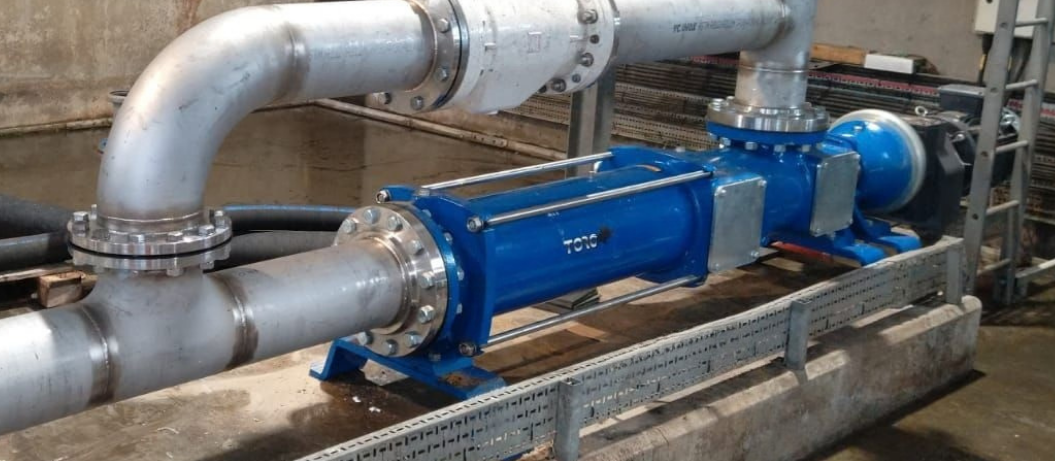
Case in point: At a United Utilities site, conventional centrifugal pumps limited thickened sludge handling to approximately 3% DS. By replacing the existing duty unit with a positive-displacement peristaltic hose pump, the plant achieved more efficient transfer at up to 12% DS.
The operational impact: Quadrupling the solids concentration removed 75% of the liquid volume previously requiring transport, reducing tanker movements by nearly three-quarters while maximising the capacity of upstream dewatering plant.
2. Account for Non-Newtonian Rheology and System Losses
Thickening primary or digested sludge causes its rheological behaviour to change rapidly. Viscosity rises exponentially with small increases in dry solids, altering laminar flow profiles, increasing frictional friction-head losses, and elevating inlet NPSHr requirements.
A pump selected on a clean-water or dilute-sludge curve will underperform when faced with thixotropic or dilatant sludges. Such fluids thin or thicken when under the influence of shear-stress, leading to .
Inlet dynamics: High-viscosity sludge restricts flow through standard inlet ports, starving the displacement chamber and inducing cavitation or premature hose/stator degradation.
Line friction: Discharge friction losses spike, forcing standard positive displacement units to operate at the far edge of their pressure curves, leading to accelerated wear or internal slip.
Process choke points: Sludges that thicken with shear force can cause line blockage or pump burnout.
Positive displacement pumps—such as peristaltic hose and progressive cavity pumps—see an increase in efficiency with higher DS, unlike rotodynamic units. Pumping higher concentrations of sludge at less volume and speed can release large energy savings.
3. Eliminate Mechanical Parasitic Losses and System Wear
Even an optimally sized wastewater pump will suffer efficiency degradation if wear components, line restrictions, or poor suction arrangements are over-looked. Because thickened sludge often carries abrasive grit, rags, and calcified solids, mechanical wear translates directly into higher specific energy consumption (kWh/m³ transferred):
Internal slip & ragging: In rotor/stator configurations, abrasive wear increases clearances, causing internal slip that demands higher shaft speeds and power to maintain throughput. Ragging around impellers or valves creates issues from ongoing friction to total blockage.
Condition monitoring: Tracking baseline motor current draw, delta-P across the pump head, and transfer duration identifies hydraulic deterioration long before thermal trips or mechanical blockages occur.
True seal-less transfer: Peristaltic units isolate the fluid entirely within an elastomer hose element, removing mechanical seals, valves, and internal dead zones that cause friction, leakage, and downtime.
4. Identify small steps that add up across the works
True efficiency extends well beyond the motor nameplate. When evaluating pump performance, process engineers measure gains across three critical plant metrics:
Haulage and transport fuel: Every percentage point gain in sludge cake or liquid % DS directly cuts tanker loads, transport emissions, and storage demand.
Process unit utilisation: Reliable high-density pumping prevents downstream bottle-necks, enabling upstream dewatering equipment to run at continuous optimal setpoints.
Specific energy consumption: Measuring the electrical energy consumed per dry tonne transferred (kWh/tDS), rather than pure volumetric output, reveals the true operational cost of the asset.
Engineering Your Transfer Stage
Many WwTW are discovering the value of matching the pump type to the actual characteristics of the sewage at that specific stage of treatment. Also, by dewatering and concentrating sludge at an earlier step, they can utilise more specialist pumps, transforming site performance. Reducing haulage frequency, securing continuous uptime, and lowering operational costs pump-by-pump pays long-term dividends.
Get in Touch
Atlantic Pumps provides rapid, application-engineered fluid handling solutions tailored to aggressive slurries and high-solids wastewater. To review your site’s sludge transfer duties, head loss calculations, or pump sizing, speak to our technical engineering team or watch our training videos.
- Blog
- Water & Wastewater
- Anaerobic Digestion and Biogas