September 2 2026
 5 min read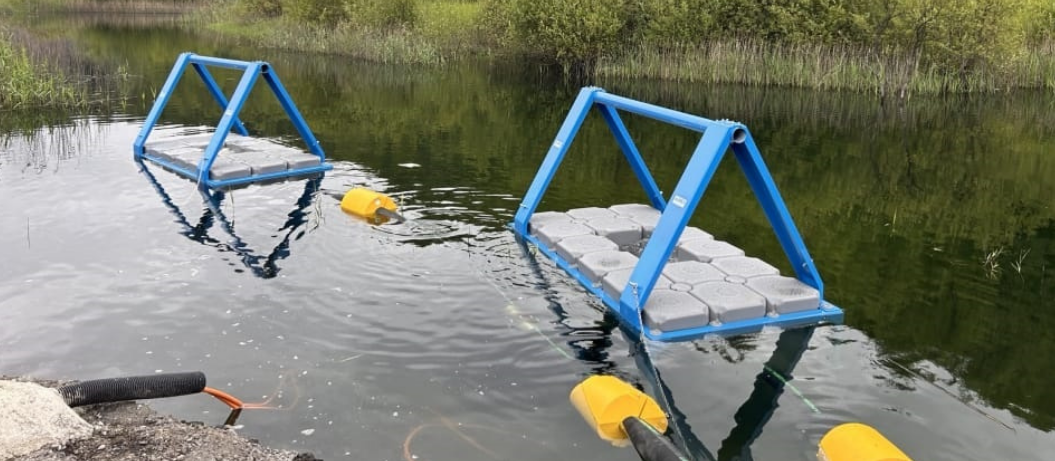
When pumps are deployed in open water environments – such as settling ponds, lagoons, and dewatering projects – fixed installations quickly show their limitations. Fluctuating water levels, difficult access, and unstable suction conditions can all impact pump performance. Dry-sited pumps can get flooded over, or lose suction prime during dry seasons. Submerged pumps at the bottom of the waterbody get blocked by silt. This raises an important question: Is there a more flexible way to operate?
Pump pontoons or ‘floating pump platforms’ are at least part of the answer to this question. In quarrying operations, where dewatering requirements constantly shift as excavation depths increase and water levels fluctuate, floating pump platforms provide a more adaptable and reliable alternative to fixed pumping installations.
In this article, we explore how pump pontoons work, why they are widely used in quarry dewatering, and how they help operators manage changing site conditions more effectively.
What are pump pontoons and how do they work?
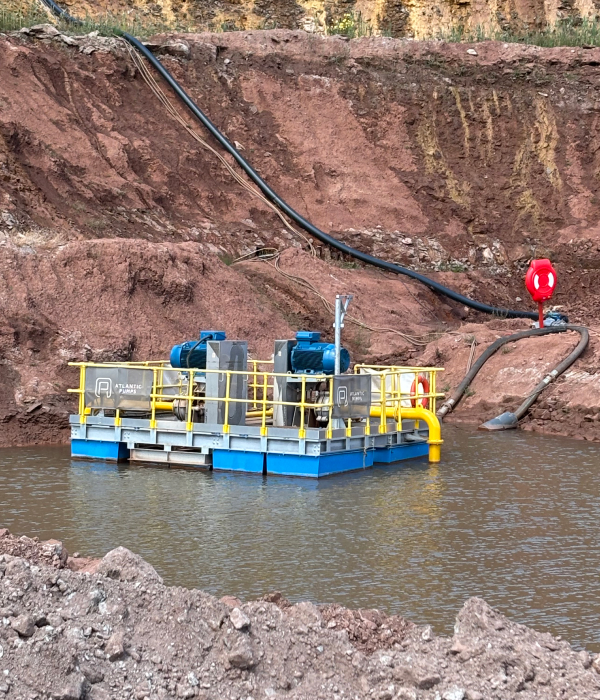
Pump pontoons are floating platforms (like sturdy rafts) capable of carrying pumps and related equipment on open water. So instead of placing a fixed pump on land, you mount the asset on a floating structure so that it can operate directly on lagoons, rivers, lakes, reservoirs, or flooded areas.
You may also have heard the terms ‘floating pump platform’ or ‘floating pump – these are alternative terms for the same equipment. In quarrying and mining applications, pump pontoons are commonly used to support submersible pumps operating in lagoons, settlement ponds, and flooded excavations where stable positioning and changing water levels are ongoing operational challenges.
Here’s a rundown of the main components and how they work:
Floating platform/pontoon base
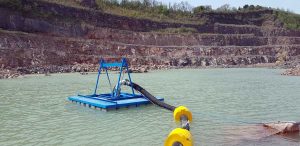
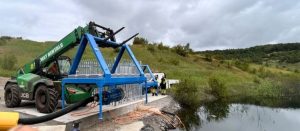
The pontoon is usually made of a steel and heavy-duty plastic float. This keeps everything buoyant and stable on the water surface. The latest Audex pontoons feature a top bar designed for easy lifting by crane or tele-handler, making inspection or re-deployment easier and safer.
Pump system
A centrifugal pump is attached to the platform, either a fully submerged type suspended underneath or a dry-sited version atop the floating deck. They are best powered by an electric motor, to eliminate the risk of fuel spillage and to reduce the need for ‘work over water’ risk management.
Intake (suction side)
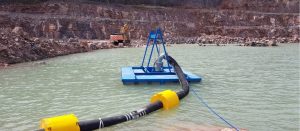
Centrifugal pumps benefit from a flooded-suction end, or a very short suction line. Submersible pumps are suspended below the pontoon – protected from floating debris and bottom silt to take off the clearest water. For pumps mounted on top of the floating deck (usually the larger models), the natural rise and fall ensures the suction pressure remains stable.
The advantages of floating pump platforms
Floating pump platforms keep the inlet right at the most efficient point, despite the inherent rise and fall that’s typical in dewatering operations. With less suction pipe length than land-based pumps, the risk of cavitation and loss of prime is greatly reduced.
Being close to the source, floating pumps also perform better with mud, sediment and debris-laden water than fixed pumps, making them especially useful in ‘wet civil’ engineering, dredging, and dewatering of excavations
Result: Lower maintenance, smoother operation, energy savings.
As the platform automatically rises and falls with the water level, there is no need to manually reposition the pump as the levels change. In many open-pit mines and quarries, storms can cause water levels to rise quickly – at the same time as making access to the pumps difficult and dangerous during emergency flood responses. Many a dry-sited pump has been flooded out and ruined by being inundated with rainfall during unstaffed hours. A pontoon takes the pressure off when your staff resources are most strained.
Result: Safety gains, uptime, lowered risk of water damage to electrical motors and control panels.
Floating pump platforms can be fitted with shore-based retrieval aids, floating access walkways, or davits to aid safe and convenient inspection, maintenance, or relocation. For quarry managers, this flexibility becomes increasingly important as extraction depths increase, lagoons are relocated, and pumping locations need to move.
A floating pump also averts the need to build concrete bases or pumping stations to support the asset, saving time, labour, and construction costs.
Pump pontoons are extremely mobile and flexible, and can be easily moved using a tow boat, winch, or cable from the landside. Most can be craned out and moved across your site with readily available site equipment (check Owner’s Manual).
In many quarrying applications, simpler pontoons are used that are designed purely to support the weight of the submersible pump itself. When maintenance or inspection is required, the pontoon and pump are simply towed back to the bankside and recovered using a crane or telehandler. This provides a practical and cost-effective solution for temporary or lower-access installations.
Larger, walk-on pump pontoon systems are also available for maintain-in-place and easy access is required. These platforms can support both submersible and ‘dry-sited’ pumps and are designed so maintenance teams can safely carry out inspections and servicing directly on the pontoon itself. Some systems also include onboard davits, allowing submersible pumps to be lifted and returned without requiring separate lifting equipment, effectively creating a self-contained floating pumping platform.
How to select the right pump pontoon design for your operation
Selecting the right pump pontoon design for your operation requires matching the platform to your working conditions and performance needs.
The starting point is the weight of the pump and whether a working platform is desirable. Audex pontoons are highly configurable, covering the vast majority of mine and quarry lagoon dewatering, dredging, raw water abstraction, and river engineering scenarios. They are engineered using high-buoyancy, corrosion-resistant materials and components for maximum durability, flexibility, and lifetime. The choice between a simple pump-support pontoon and a larger maintenance-access platform will depend on factors such as pump size, access requirements, maintenance frequency, and how often the pontoon is expected to be relocated.
Flow and head affect the dynamic loading from pumps and piping, since larger pumps demand bigger, more stable pontoons with sufficient load-bearing capacity and balance. Some industrial pontoon systems can support several tonnes of equipment and personnel, being built from modular interlocking sections for scalability and ease of expansion while maintaining their structural stability and load distribution.
Further information
Further reading can be found on our dedicated Audex pontoons page. You may also find our case studies helpful, particularly:
Lagoon Dewatering at British Steel
Quarry Dewatering At Breedon Wenvoe
Get in touch
Our team can also advise on the most suitable floating pump platform setup for your water management application. Simply call 0800 118 2500 or message us via our contact form.
We also take a sustainable approach to our work and are committed to reducing energy waste from pumps. Our expert knowledge allows us to reduce energy usage by 20% on the average site!
Call us today on 0800 118 2500 for more information.