July 10 2026
 4 min read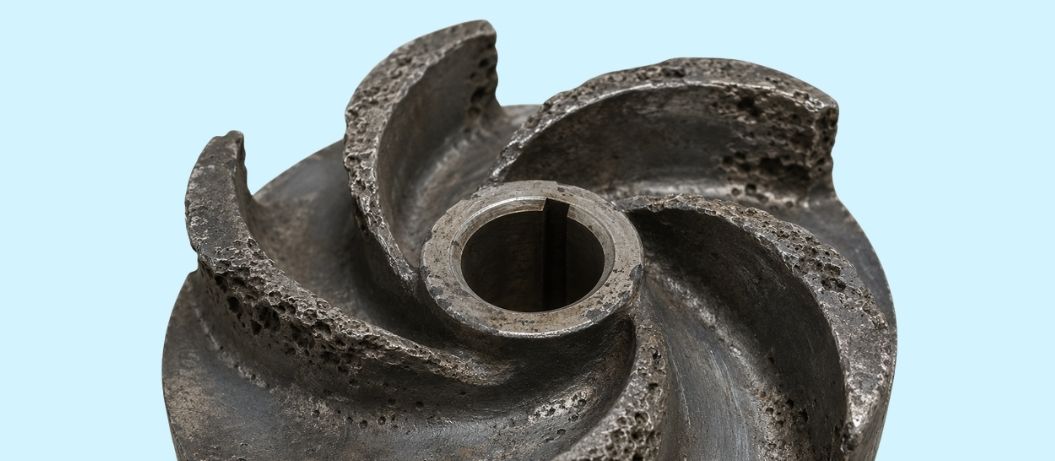
Cavitation is one of the most destructive phenomena in fluid handling yet often goes unaddressed until a valuable asset becomes a write-off.
It doesn’t just lower your system’s operating efficiency; it systematically eats away at your internal components.
Cavitation is caused by:
a) fluid ‘starvation’ – low pressure on the suction supply, or
b) recirculation – where a zone of reverse flow forms.
The Lifecycle of a Cavitation Bubble
To fix cavitation, we first need to understand what is physically happening inside. Cavitation is a two-stage process driven purely by rapid local pressure changes:
Stage One: Vaporisation (Low Pressure) As fluid enters the suction eye of the impeller, its velocity increases, causing its static pressure to drop below the liquid’s vapour pressure. The liquid begins to boil locally, forming thousands of micro vapour bubbles.
Stage Two: Violent Collapse (High Pressure) As these vapour bubbles move into regions of higher discharge pressure, they instantly collapse. The surrounding fluid rushes in to fill the void, generating micro-jets with supersonic shock waves.
How to Hear It: The Site Audio Test
The most immediate tool you have for detecting cavitation is your own ears. Cavitation has a very distinct, unmistakable acoustic profile:
- The “Pumping Gravel” Illusion: Cavitation often sounds like the pump is trying to process gravel, marbles, or large stones—easier to spot if you are pumping clean water or fine slurry but too easily ignored on aggregate-slurry pumping duties!
- High-Frequency Crackling: Recirculation cavitation often manifests as an erratic crackling or popping sound coming from the pump or the immediate pipework.
- Rattling and Vibrational Noise: The violent collapse of bubbles introduces mechanical imbalance, leading to a deep rhythmic rattling or random knocking that shakes the bearings and support structures.
Top Tip: If you notice an abrupt increase in localised vibration levels alongside these characteristic sounds, turn off the pump and check your suction side immediately. Do not ignore a pump that has suddenly started sounding like a rock crusher.
How to See It: The Damage Profile
Because the pump case is sealed and often submerged, you usually only see cavitation visually after disassembling the unit for inspection.
- Sponge-Like Erosion Pitting: Cavitation leaves a very specific fingerprint. Unlike normal abrasive wear—which smoothly thins out impeller vanes—cavitation creates a localised, jagged, sponge-like pitting pattern. It looks as though the metal has been physically chipped away.
- Targeted Placement: The damage location is a clue to the cause. Low NPSHa cavitation pitting is concentrated heavily on the leading edges of the impeller, whereas suction recirculation cavitation appears on the outer curve of the vane, just after the leading edge. Discharge (recirculation) cavitation damage occurs mainly on the trailing edges, outer rim of the shroud, and on the volute cutwater.
- Secondary Thermal and Mechanical Failures: The excessive vibration and localised thermal energy can quickly ruin surrounding components. Look for distorted mechanical seal faces, scorched or leaking gaskets, and premature bearing failure characterised by spalling on the raceways.
How to Stop It: Actionable Engineering Solutions
Stopping cavitation means ensuring that your system’s NPSHa (Net Positive Suction Head Available) is comfortably higher than the NPSHr (Net Positive Suction Head Required) at the pump inlet, and maintaining flow above the pump’s Minimum Continuous Stable Flow (MCSF) rate. Here are five practical solutions to consider implementing on your site:
A. Optimise Your Suction Pipework Layout
Restricted suction is the number one cause of classic suction cavitation. Ensure your intake lines are as straight and short as possible. Avoid placing elbows, reducers, or valves directly upstream of the pump, as they create turbulent vortices and pressure drops. Always use eccentric reducers (flat side on top) rather than concentric ones to eliminate air pockets.
B. Control Fluid Velocity
Classic Suction Cavitation: Increasing the diameter of your suction pipework lowers intake velocity, raises intake pressure (NPSHa), and feeds the impeller smoothly.
Discharge or Low-Flow Cavitation: If you suspect recirculation, check for pipe restrictions or blockages and try lowering the discharge pipe outlet to reduce the TDH. Reducing the discharge height or increasing the discharge pipe diameter shifts the operating point toward higher flows. Consider installing a VFD to decrease RPM to match lower system demand, or replace the pump with a lower-flow design. A recirculation bypass line can help maintain minimum flow during demand fluctuations, although it can waste energy.
C. Lower the Liquid Temperature or Clean Suction Strainers
Hotter fluids have a much higher vapour pressure, making them boil far more easily. If your liquid temperature rises, you need significantly more suction head to prevent vaporisation. Also, keep an eye on suction strainers; a partially blocked intake strainer creates conditions for cavitation.
D. Increase suction head pressure (NPSHa)
Increase the height of fluid above the pump inlet level, either by lowering the pump or stopping the pump before the supply level drops too low. This increases NPSHa.
E. Stop “Oversizing” Your Pumps
Avoid specifying a larger pump, “just in case” extra capacity is needed later. Operating a centrifugal pump far to the left of its Best Efficiency Point (BEP) causes low-flow internal recirculation. This creates deep pressure drops within the casing, which can induce cavitation even if your external suction head is sufficient. If you need low flow, specify it accurately rather than relying on an oversized pump.
Experiencing Pump Vibrations or Drop in Flow?
If you suspect cavitation is eating your impellers or causing premature bearing failure, don’t wait for total asset failure. Contact our technical team of fluid handling experts at Atlantic Pumps today on 0800 118 2500 to audit your suction conditions, optimise your system layout, or discuss a better pump solution.
We also take a sustainable approach to our work and are committed to reducing energy waste from pumps. Our expert knowledge allows us to reduce energy usage by 20% on the average site!
Call us today on 0800 118 2500 for more information.