June 24 2026
 3 mins min read
Here, we take a deep dive into vibrations in pumping systems and learn about a critical tool in your proactive pump maintenance toolkit: vibration analysis.
We often talk about establishing vibration baselines when your pump is running smoothly. But when a sensor flags a spike in vibration, what is the pump actually trying to tell you?
Think of your pump as a patient and vibration analysis as an ECG. Different mechanical issues leave distinct “fingerprints” at specific frequencies. By reading these signatures, you can catch internal damage before it doubles your repair bill.
Here is a practical guide to reading pump vibration signatures and what each frequency range typically means.
The Fundamentals: What is ‘1X’?
Before looking at the frequencies, we need to establish our baseline metric: 1X RPM (Running Speed).
E.g.
- If your pump motor is spinning at 1,500 RPM, then 1X = 1,500 CPM (Cycles Per Minute), which is 25 Hz (Cycles Per Second).
- All vibration signatures are analysed as multiples of this fundamental running speed (1X, 2X, 3X, or multiples of the number of impeller vanes).
To put it simply, a shaft vibration that peaks exactly at 2X is ‘thumping’ twice for every rotation.
-
The 1X Frequency: Unbalance
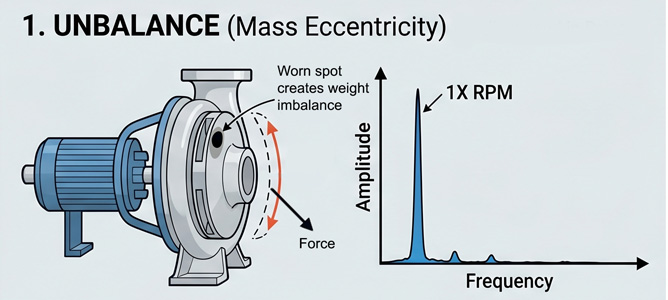
If you see a massive spike exclusively at the 1X running speed frequency, you are almost certainly looking at mass unbalance.
- The Signature: A dominant peak at 1X in the radial direction (horizontal or vertical).
- What’s Happening: The mass centre of the rotating element doesn’t align with its geometric centre. In our world, this is frequently caused by uneven impeller wear from abrasive fluids, a partially blocked impeller eye, or a lost balance weight.
- Take Action: Inspect the impeller for erosion, material build-up, or damage.
-
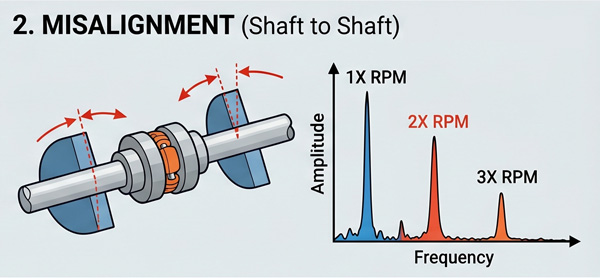
The 1X, 2X, and 3X Frequencies: Misalignment
When you see distinct peaks at 1X, 2X, and more rarely 3X running speed, the culprit is usually misalignment between the pump and the motor shafts.
- The Signature: High axial vibration (along the direction of the shaft) alongside radial peaks at 1X, 2X, and 3X. A dominant 2X peak is a classic indicator of angular misalignment.
- What’s Happening: The shafts of the pump and motor are not on the same centreline, forcing the coupling to flex twice per revolution. This places extreme, uneven mechanical stress on your bearings and mechanical seals.
- Take Action: Check coupling wear and perform a precision laser alignment.
-
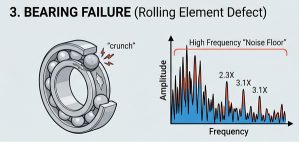
High, Non-Integer Frequencies: Bearing Failure
Bearings don’t usually fail at neat multiples like 1X or 2X. Because ball bearings roll on their inner and outer races, they generate unique high-frequency vibrations based on their own geometry.
- The Signature: Non-integer peaks (e.g., 3.2X, 4.7X) occurring at high frequencies, often accompanied by a broad “noise floor” rise.
- What’s Happening: The rolling elements are hitting microscopic pits, cracks, or spalls on the bearing races.
- Take Action: Plan a proactive bearing replacement during the next scheduled window before the bearing seizes and damages the shaft.
-
Vane Pass Frequency (VPF): Hydraulic Forces & Cavitation
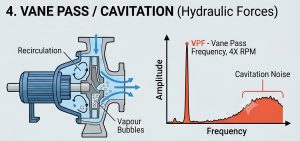
The Vane Pass Frequency is calculated by multiplying the running speed (rpm) by the number of vanes on your impeller (VPF = rpm x number of vanes).
- The Signature: A sharp peak at the VPF, or a massive, chaotic “hump” of high-frequency random noise across the spectrum.
- What’s Happening: A clean peak at VPF usually indicates internal recirculation or operating too far away from the Best Efficiency Point (BEP), creating pressure pulses as the vanes pass the pump volute cutwater.
- A broad, raised “hump” of random high-frequency noise sounds and looks like pumping gravel. This is the classic signature of cavitation—where vapour bubbles form and violently implode against the metal components.
- Take Action: Check your suction conditions (NPSH), ensure you aren’t running the pump at a severely restricted low flow, and verify that the suction valve is fully open.
Move from Reactive to Proactive
Catching these frequencies early is the dividing line between an inexpensive, scheduled parts swap and a catastrophic, expensive site shutdown.
Are you looking to set up a regular condition monitoring routine or need help troubleshooting a troublesome asset? Reach out to our reliability team at Atlantic Pumps on 0800 118 2500.
We also take a sustainable approach to our work and are committed to reducing energy waste from pumps. Our expert knowledge allows us to reduce energy usage by 20% on the average site!
Call us today on 0800 118 2500 for more information.