January 14 2026
 6 min read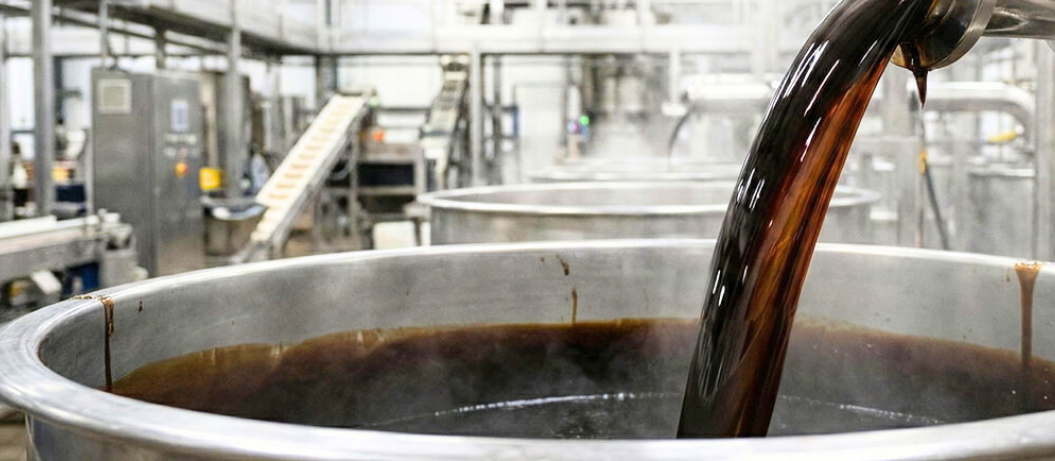
We’d like to thank ED&F Man, global suppliers of Molasses, and Dropworks Distillery for their insights and assistance in creating this article.
If you know a bit about molasses, you’ll understand why it is so difficult to pump. The dry-matter (DM) content of shipped molasses is 75 – 80%, enabling efficient transport and storage – but making it challenging to move with standard pumps.
A deeper understanding of molasses properties and rheology helps us handle it at scale, improve pumping efficiency, and overcome the problems often encountered when moving it through production processes.
Strong contenders for molasses pumps are peristaltic, lobe, and progressive cavity types. Centrifugal pumps are not suited. The actual pump model and size to select depends on volume, pressure requirements, and specific molasses grade.
A valuable co-product
Molasses is a complex, highly viscous fluid. A co-product of sugar refining, it remains rich in energy-boosting vitamins and key minerals, making it a valuable ingredient in many human and animal feed products. It is also used as a functional catalyst in horticulture, fermentation, renewable energy, wastewater treatment, and even brick making.
Of course, we can’t talk Molasses without mentioning rum, and we’d like to acknowledge the assistance that Dropworks, the largest rum distiller in Europe, has given us. They turn molasses into ‘liquid gold’!
Challenges in Pumping Molasses
As far as pumping systems are concerned, the key properties of molasses are:
- High Viscosity – which is influenced by multiple factors
- Temperature sensitivity
- Density – high solids content. Typical 1.42 – 1.46 specific gravity.
- Clogging (from caramelised chippings or unfiltered supply)
Molasses is a non-Newtonian fluid, a thixotropic one at that, which, put simply, means its viscosity (flow resistance) decreases with prolonged shear stress and gradually re-thickens when left to rest.
Another key factor in handling is temperature; low temperatures can significantly affect pumpability, whereas too high a temperature can deform the sugar content, promote unwanted fermentation, or even cause caramelisation.
Cleaning down, whether for hygiene, product change-over, or routine maintenance tasks, is crucial in any food or pharmaceutical production process. This can be a sticky, time-consuming task with molasses!
What is the Best Pump for Molasses?
Centrifugal pumps are not recommended for molasses, as they are likely to burn out, experience intake cavitation, or trigger crystalisation. Rather, positive displacement pumps enable turbulent-free operation, handle a wide range of viscosities, and provide better control of dose rate and flow.
The main candidates are:
-
Lobe pumps
Relatively simple in principle, lobe pumps offer reliable performance with molasses. They produce a pulsation-free flow and can handle molasses at high viscosities. However, they require protection from dry-running and need expensive mechanical seals to prevent leakage.
-
Peristaltic hose pumps
These pumps have strong self-priming ability, gentle rotation, low shear, and are easy to clean and maintain. Only the hose comes into contact with the liquid, and, as they are self-sealing/sealless, they are inherently leak-free. The rollers that create the cavities protect against slippage and backflow. They pass solids well, making them equally good for pure molasses or mixed formulations. While most peristaltic pumps can tolerate short periods of dry running, the LSM one stands out in this regard as it can run dry for extended periods.
-
Progressive cavity pumps
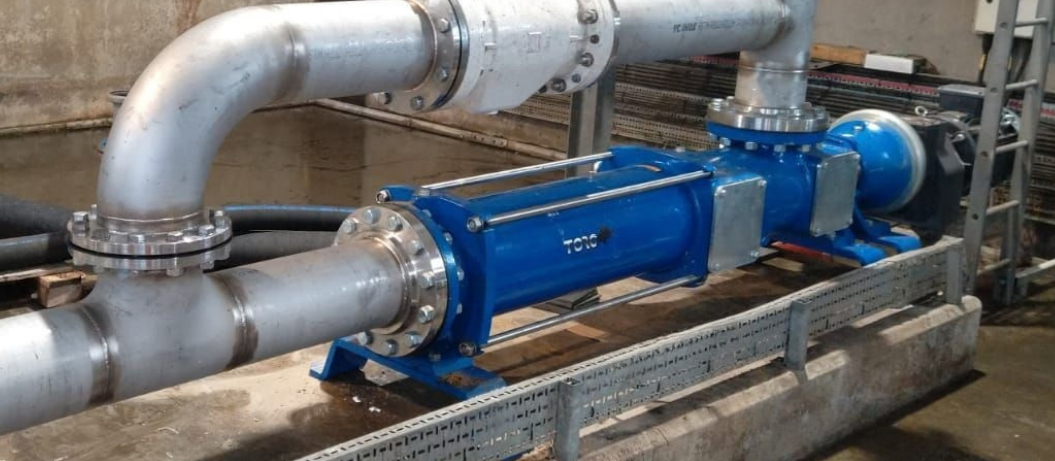
Progressive cavity (PC) pumps excel at handling high-density, smooth fluids such as molasses. Low-shear and pulsation-free, their close clamp enables effective transfer of the widest range of viscosities, from concentrated molasses solubles (CMS) to highly diluted blends.
-
Sliding vane pumps
Sliding vane pumps demonstrate good flow sustainment over time with smooth, non-abrasive fluids. This is the result of the vanes self-compensating for wear, as the vanes slide out until they meet the chamber wall. However, their capabilities are challenged by high viscosity, making them less effective for undiluted or unheated molasses.
The Importance of Specifying the Right Pump
The importance of choosing the best pump type is underscored by ED&F Man Liquid Products’ switch to a new pump technology. Ian McKenzie, UK Operations Manager at ED&F Man, reported a 30% reduction in energy use and an increase in uptime by changing the pump type used across their distribution network. The incumbent pumps often tripped out during the colder months, whereas the new pumps proved much more stable and efficient at all viscosity levels.
Important factors in pump selection include:
- For molasses, this is usually quoted in centi-poise (cP)
- Volume/flow rate Can be quoted in litres per min (l/m) or cubic metres per hour (m3/hr)
- Flow Resistance. This is determined by pipe material, length, inner diameter and ‘interruptions’ such as bends, valves, and sensor probes.
- Pressure and head This basically means the height difference from source to destination, plus any pressure required at the discharge end. It’s not usually a big factor in simple tank-to-tank transfers, but it should stay within a sensible window to perform the lift without wasting energy. The head height is added to the flow resistance to calculate the ‘total head pressure’ required.

Progressive cavity pumps in situ

Left to right: Lobe pump, progressive cavity pump, peristaltic pump
Best Practices for Pumping Molasses Efficiently
Temperature control and Dilution
One time-tested way to increase the pumpability of molasses is to warm it to 35-40 0C, and this is how commercial traders like ED&F Man transfer it quickly from ship to truck. The purity of the molasses and their low-energy, temperature-controlled system enable this to be done without concern. However, processors should be aware that within this temperature range, the introduction of contaminants can trigger uncontrolled fermentation, leading to gas production, expansion, and product spoilage.
Fermentation is avoided by good hygiene practices, which prevent contamination by yeast, bacteria, and mould spores. Overheating and temperature shock are avoided by accurate controls and wide-area heat transfer surfaces.
As the chart below shows, even a temperature difference of 100C can make a big difference to viscosity.

Dilution – blending with water
The second method to improve pumpability is to loosen it up with the addition of water. This can benefit end users of molasses, who might not have access to energy-efficient or molasses-safe heating. Also, the risk of caramelising the liquid, which typically happens with heating coils, is removed.
Alistair Hugill, UK Commercial Manager at ED&F Man, explains that as little as a 2 or 3% water addition goes a long way, as it breaks the ionic bonds that are primarily responsible for molasses’ syrupy nature. The small addition of water means energy savings when pumping, without bulking it out too much for storage and transport. This makes ED&F Man’s custom-blending service popular, as customers can buy molasses at the level of dilution that best suits their process.
The chart below shows the relationship between centi-poise (cP) and concentration/dilution for molasses from various sources. A couple of percentage points drop in solids content results in a around 50% drop in viscosity, depending on grade.

Correct pump sizing and material selection
The density and viscosity of molasses require powerful pump motors, and a robust drive shaft to withstand the torque, especially at startup, when the molasses has been still for a time. Ensure specific gravity (SG) is considered when selecting a pump type and size. See the chart below, which shows the correlation between SG and DM (Dry Matter %) of sampled molasses.

Cane molasses, while not particularly corrosive itself, shares a similar pH range to coffee, and its vapours (from heating) can be as low as pH 2. Therefore, stainless steel, NBR or EDPM elastomer, and special coatings are often used for molasses pumps, pipes and tanks.
Importance of speed control
Speed control is crucial for pumping molasses; ‘slow-to-flow’ is the theme. Gearing can convert rotational speed into high torque power, while VFDs (variable frequency drives) allow fine-tuning of the flow rate. A tip from Mackenzie is to start the pumps at a low speed at the beginning of the day or shift, and gradually increase the speed as the molasses warms and starts to flow more freely.
Frequently Asked Questions
Can molasses damage pumps?
The main thing to avoid damage is ensuring the pump and its motor can handle the density/specific gravity. So long as it is filtered, and no caramelisation occurs, there is low chance of abrasion or blockage if suitable pump types are used.
What temperature should molasses be pumped at?
High volume handlers pump pure molasses at over 400C, as this reduces the viscosity to a level for efficient flow without degrading the product. In circumstances where this temperature range is unviable, adding clean water can be a low-cost way to increase pumpability and energy efficiency. This could mean that protection from freezing may be necessary in cold environments, so consider fitting pipe lagging and heated jackets on the pumps.
Is molasses pumping different in food vs industrial applications?
Hygiene is a critical factor in food production, so choose pumps that are easy to clean, have no cavities where fluid can recirculate, and seal molasses from external contamination and leakage. If molasses will come into contact with shafts or bearings, then the materials and lubrication of these needs careful consideration.
Components such as back-check valves can make line cleaning difficult, so positive displacement pumps that automatically seal against back-flow are beneficial.
For these reasons, pumps without shafts and bearings, and those with good self-sealing capabilities, are the best option for food and pharmaceutical-grade molasses.
Conclusion
Molasses may be naturally difficult to pump, but with the right equipment and knowledge, it can be done efficiently and effectively. Many grades and pre-blends are available from global traders like ED&F Man, and our pump specialists can advise on the best setup for moving molasses through your production processes.
We also take a sustainable approach to our work and are committed to reducing energy waste from pumps. Our expert knowledge allows us to reduce energy usage by 20% on the average site!
Call us today on 0800 118 2500 for more information.