July 28 2026
 2 min read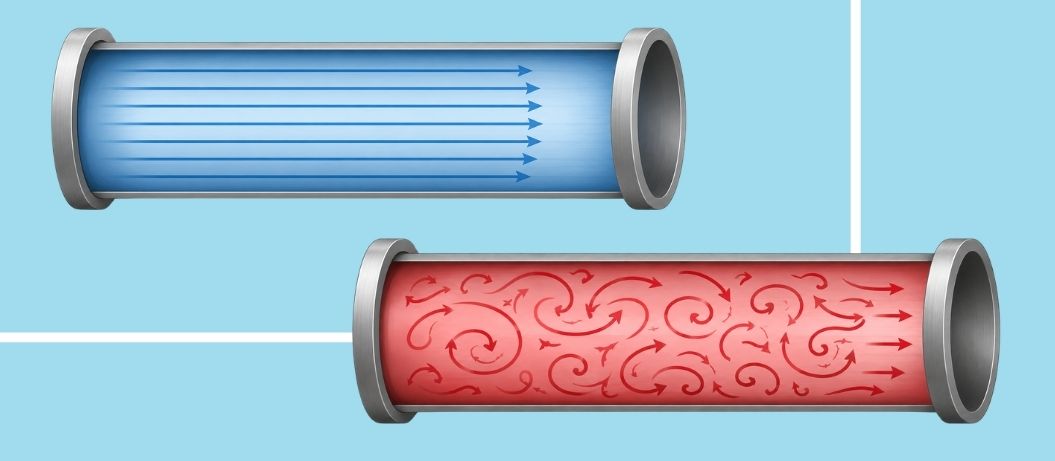
When it comes to pumps and piping, most people don’t think beyond the liquid simply moving from A to B. However, how that liquid flows through your pipework directly affects friction losses, energy consumption, pump selection, and wear patterns.
Understanding the distinction between laminar and turbulent flow is key to optimising your pump process efficiency.
1. What is Laminar Flow?
In a laminar flow regime, the fluid moves in smooth, parallel layers with minimal mixing between them.
- Characteristics: Predictable, orderly, and streamlined.
- Where it occurs: Typically found when pumping viscous liquids (like thick sludges, oils, or heavy slurries) at low velocities.
- Impact on pumping: Fluid layers glide over each other, with the highest velocity in the centre of the pipe and zero velocity right at the pipe wall. Friction losses are directly proportional to fluid velocity.
2. What is Turbulent Flow?
As velocity increases or viscosity decreases, the smooth layers break down into dynamic, chaotic eddies and vortices.
- Characteristics: Highly chaotic, rapid cross-current mixing, and unpredictable particle paths.
- Where it occurs: Standard for low-viscosity fluids (like clean water) moving at high speeds or through rough, restricted pipework.
- Impact on pumping: Turbulent flow creates greater internal mixing and generally results in higher friction losses than laminar flow. This increases the head the pump must overcome and can raise energy consumption, particularly when fluid velocities are unnecessarily high.
The Boundary Line: The Reynolds Number (Re)
Engineers determine the flow regime using a dimensionless quantity called the Reynolds number (Re):
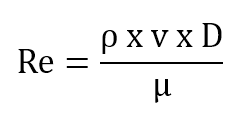
ρ (rho): Fluid density – in kg/m3
v: Average fluid velocity – in m/s
D: Internal pipe diameter – in m
μ (mu): Dynamic viscosity – in Pa – s (Pascal-seconds)
Rule of Thumb:
Re < 2000: Laminar Flow
2000 < Re < 4000: Transitional Flow (unstable, alternating between regimes)
Re > 4000: Turbulent Flow
Key Takeaways for Process & Site Managers
- Energy Costs: Operating deep inside the turbulent regime escalates friction head losses, forcing your pump to work harder and consume significantly more energy.
- Slurry Settlement: While turbulence wastes energy, it isn’t always bad! When pumping settling slurries, a degree of turbulence is required to keep solid particles suspended and prevent pipe blockages.
- Pump Performance: Viscous fluids operating in laminar regimes reduce centrifugal pump performance, often requiring a positive displacement pump (like a peristaltic or progressive cavity pump) to maintain efficient discharge rates.
Get in Touch
Need assistance sizing pipework, calculating head loss, or selecting the right pump technology for your process? Contact our expert team at Atlantic Pumps on 0800 118 2500 or click here to message us.
We also take a sustainable approach to our work and are committed to reducing energy waste from pumps. Our expert knowledge allows us to reduce energy usage by 20% on the average site!
Call us today on 0800 118 2500 for more information.