July 22 2026
 3 min read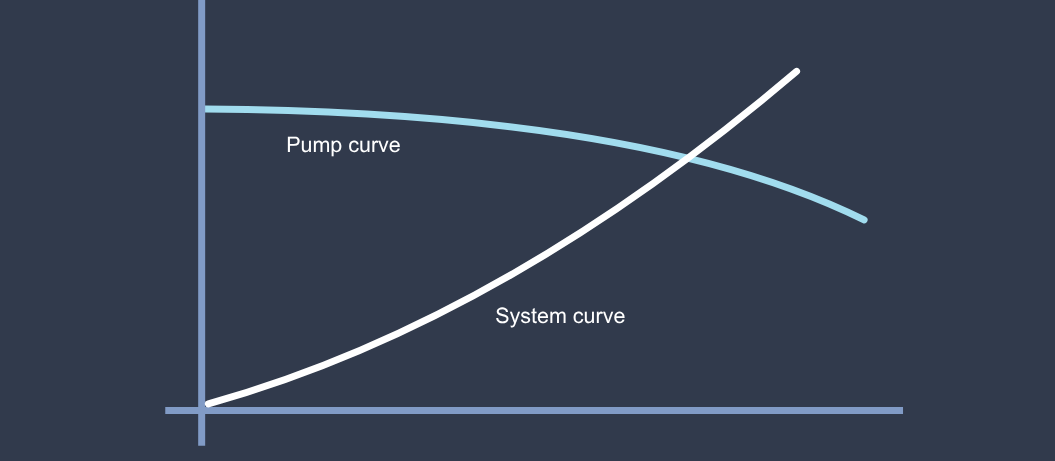
When troubleshooting a system that isn’t performing, we often point fingers at the pump. But more often than not, the culprit isn’t the pump at all—it’s a misunderstanding of the system curve. Before we dive in, let’s clear up a very common mix-up:
System Curves & Pump Curves: A pump performance curve shows the relationship between flow-rate and head pressure, based on a brand-new pump operating with clean water (typically at 20°C).
The system curve has nothing to do with the pump itself. It represents the “piping highway” your liquid must travel through, with all its friction and resistance. Understanding how these two curves interact is the secret to a predictable, efficient pumping system.
What is a System Curve?
A system curve is a graphical representation of the energy (measured in head pressure) required to move a liquid through your pipework at various flow rates. It is made up of three main components:
1. Static Head: The physical height difference the pump must lift the liquid, plus any pressure difference between the source and destination vessels. This does not change with flow rate.
2. Friction Head: The resistance the fluid faces as it rubs against pipe walls, bends, valves, and fittings. Friction increases exponentially as flow rate increases.
3. Terminal Pressure: The backpressure caused by the terminal process that the pump is feeding (e.g. a hydrocyclone or filter press). Unlike open-vessel discharge, a downstream-connected process will add to static pressure.
Where your pump curve and your system curve intersect is your duty point – the actual flow and pressure at which your pump will run.
Why Your Real-World System Curve Might Be Wrong
Paper calculations are great, but the real world is messy. Here are three common duties where the actual system curve heavily deviates from the theoretical one, leading to poor performance or premature pump failure:
1. Pumping Slurries and High-Viscosity Fluids
If your system curve calculations were done using standard water formulas, they will be completely wrong for heavy duties like quarry slurry, wastewater sludge, or viscous chemicals.
The reality: Viscous fluids and suspended solids create significantly higher friction losses than clean water. This steeper friction curve shifts your operating point to the left, resulting in much less flow than expected.
2. Ageing and Scaled Pipework
Calculations for new systems assume clean, smooth-bore pipes.
The reality: Over time, pipes suffer from scale buildup, rust, abrasion, or debris accumulation. This narrows the internal pipe diameter or roughens the internal surfaces, skyrocketing the friction losses. Your system curve becomes much steeper over time, forcing your pump to work harder for less output.
3. Variable Tank Levels (Changing Static Head)
Many operators calculate their system curve based on a single static head height.
The reality: If you are drawing from a deep sump that drains down, or pumping into a header tank that fills up, your static head is constantly shifting. This moves your system curve up and down, constantly changing your duty point. If not accounted for, your pump can easily drift into low-flow damage territory or run off the end of its curve.
Get the Maths Right, Save Your Pump
Designing a system based on an incorrect system curve leads to two major headaches: either you buy an oversized pump that wastes energy and destroys itself, or you get an undersized pump that can’t meet your production demands.
If you are planning a new dewatering project, upgrading a pipe network, or struggling with a pump that isn’t hitting its targets, don’t waste time and budget by guessing. Our team of fluid-handling specialists can help you map out your actual system curve to find the perfect, reliable pump match.
Give Atlantic Pumps a call on 0800 118 2500 to discuss your project or click here to message us.
We also take a sustainable approach to our work and are committed to reducing energy waste from pumps. Our expert knowledge allows us to reduce energy usage by 20% on the average site!
Call us today on 0800 118 2500 for more information.