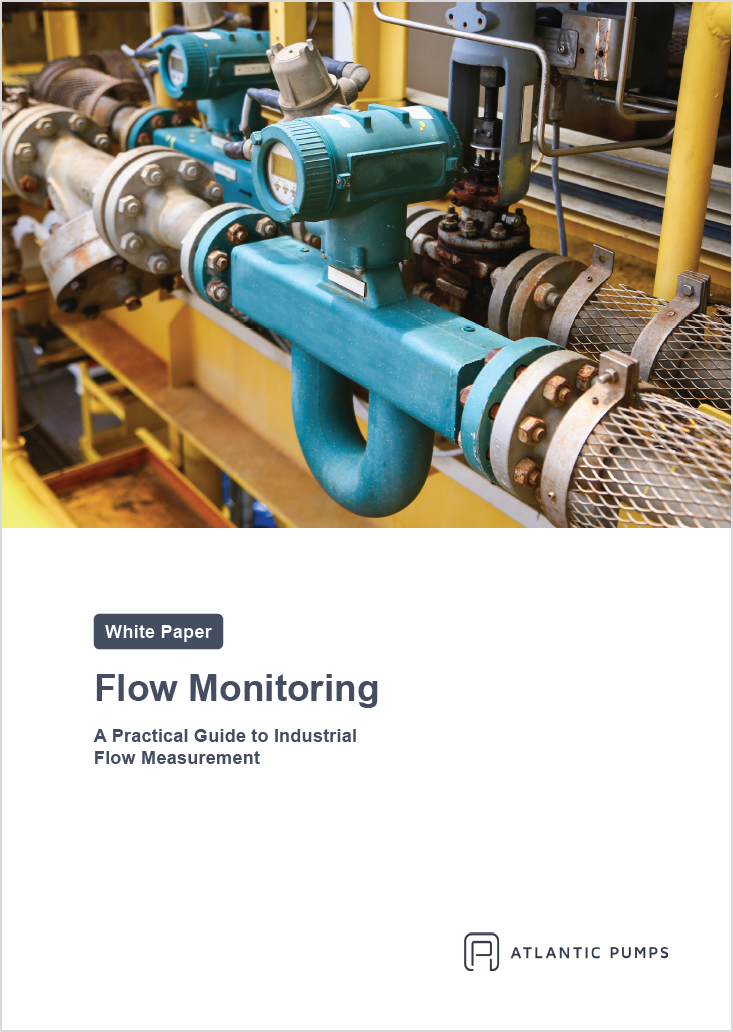
Flow Monitoring White Paper
Download our practical guide to industrial flow measurement
Simply complete the form at the end of this blog to get your free pdf copy
Flow Meters, Flow Monitoring and Pump Control
In the world of industrial pumping, you can’t manage what you don’t measure. Whether you’re overseeing a mining site, a wastewater plant, or a chemical processing facility, accurate flow measurement is not just a “nice-to-have” – it is fundamental for quality control, resource efficiency, and regulatory compliance.
Knowing exactly how much fluid is moving through your system – and at what speed – is the difference between a high-performing, well-optimised plant and one plagued by hidden costs, inconsistent results, and unexpected downtime.
Why Flow Data Matters
Flow rate can affect everything from environmental compliance and quality control to enabling predictive maintenance and extending asset lifetimes. By tracking flow volume against pressure, you gain insights into the internal health of your pump system.
Live data can alert you to wear rates, blockages, or inefficiencies long before they lead to a catastrophic failure. Designing pipe and pump systems for optimal flow is essential with abrasive, shear-thickening, or highly viscous fluids. Too high a flow rate can increase energy costs and wear rate, while low flows risk suspended solids settling out and blocking the system.
Flow parameters: Volume vs. Velocity
A common point of confusion in the field is the difference between flow volume (how much) and velocity (how fast).
- Volume is critical for billing, dosing, and compliance.
- Velocity is the “safety metric” for slurry pump operators, ensuring fluids stay above the minimum settling velocity to prevent pipes from silting up.
Your pipe’s diameter inextricably links these different parameters. A small change in pipe area – perhaps due to scale build-up or settled solids – can drastically alter your system’s performance even if your pump speed remains constant.
Selecting the Right Monitoring Technology
There is no “one-size-fits-all” flow meter. The “best” technology depends entirely on your fluid properties and process tolerance:
- Electromagnetic (Magflow): The workhorse for conductive fluids and wastewater.
- Ultrasonic: Ideal for abrasive slurries where non-intrusive sensors prevent wear.
- Coriolis: The gold standard for high-precision mass flow and density.
- Differential Pressure & Turbine: Cost-effective solutions for clean water and oils.
Choosing the wrong technology doesn’t just yield bad data; in abrasive fluid flows, it can lead to rapid equipment failure and frequent replacement costs.
Pump Choice: Positive Displacement or Centrifugal?
Flow monitoring is equally possible for any pump system, whether its driven by positive displacement (PD) pumps or centrifugal types. However, when it comes to fine-tuning flow rate, PD pumps have the advantage that their full rate is proportional to RPM. By comparison, the flow rate of centrifugal pumps is not linear, resulting in a characteristic performance curve as a function of head pressure and power.
CF pumps, whether dry-sited or submersible, are generally better for dewatering and high volume pumping where the flow volume is controlled by simple on/off switching. Where accurate dosing or precise flow control is important, PD pumps such as progressive cavity pumps or peristaltics are popular.
Installation & Setup Matters
Even the most expensive meter will fail to give useful data if installed poorly. We consistently see meters placed too close to bends or valves, resulting in turbulent flow that “confuses” the sensors. To get a true reading, you need laminar flow – the smooth, predictable movement of fluid that only occurs in straight runs of pipe. Ignoring the “Straight Run Rule” is the most common reason for erratic flow readings in the industry today.
Certain meters are sensitive to interference, so check with the supplier if you have nearby electronic equipment that could skew readings.
Magflows and Ultrasonic meters typically require calibration to the pipe’s diameter, thickness and material. Simple design errors, such as using a pipe’s diameter instead of the radius when setting up the flow meter, can result in readings being off by 400% or more.
Take the Deep Dive: Download the Full White-Paper
Precision flow measurement is both an art and a science. Because this topic is so critical to your process, we have compiled a comprehensive White-Paper that serves as a practical handbook for process managers.
Inside the full guide, you will find:
- Benefits and drawbacks of different flow meter types.
- Step-by-Step Calculations: Understand how flow is deducted based on pipe diameter, and where this can cause issues.
- The “Common Mistakes” Checklist: A guide to avoiding the top 5 installation pitfalls.
- IoT & SCADA Integration: How networking, automation and AI opens up the real value of data collection; predictive analytics, risk reduction, quality control.
- Cavitation Prevention: How to install flow sensors without markedly degrading the flow or damaging your pump.
Get instant access to the full white paper now: