April 1 2026
 4 min read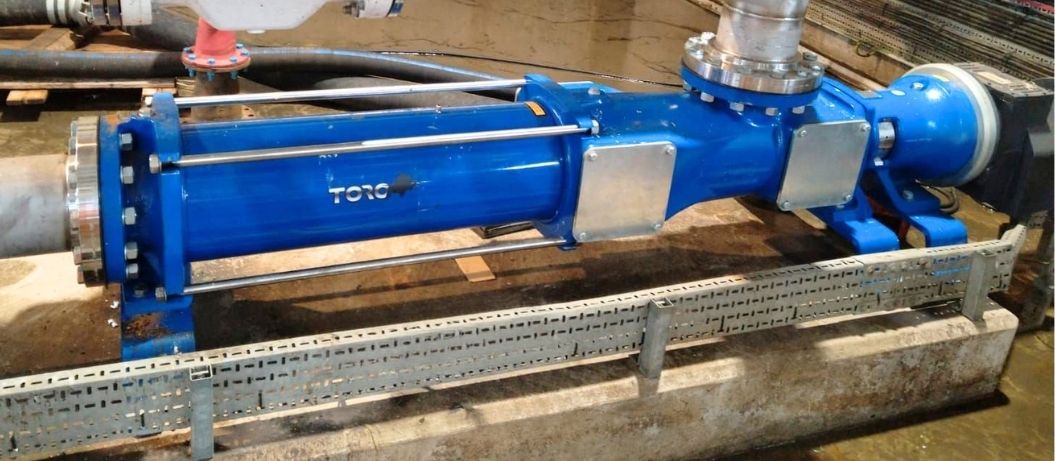
This is an in-depth series from the Atlantic Pumps Academy. You can also watch on-demand training presentations and sign up for live webinars to expand your pump knowledge.
At-a-glance:
- Large progressive cavity pumps (PCPs) require a double universal joint (U-joint) — the rotation transfers from a concentric motor to an eccentric rotor.
- There is a type of compact PCP that has a moving stator rather than a universal joint – known as a wobble pump – this doesn’t have a universal joint.
- The shaft takes a lot of strain, being the drivetrain that transfers the torque and power from the motor to the pump.
- There are two types of universal joint; the cardan joint is an advance on the standard pin joint.
- PCPs require a double cardan for a steady rotational speed. The two joints are coupled via an intermediate drive shaft.
- Understanding the design and options of universal joints helps with pump selection and maintenance.
In our previous guide to Progressive Cavity Pump (PCP) pressure, we looked at how these incredible “workhorses” use their tight-fitting clamp and multiple stages to overcome high-head applications. But although the rotor and stator might get all the glory for moving the fluid, there is a “hidden” hero working behind the scenes.
If the rotor and stator are the heart of the pump, the coupling rod and its joints are the muscles and tendons.
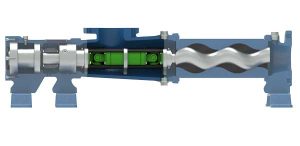
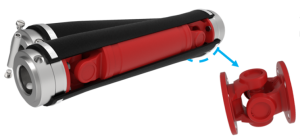
Double cardan joint and shaft in a PCP (highlighted in green)
Here, we dive deep into the PCP’s drivetrain. We’ll look at why the joints are the most stressed part of the pump, the difference between “Pin” and “Cardan” joints, and how to spot a failure before it shuts down your process.
Why the Drivetrain is the “Stress Centre”
In a standard centrifugal pump, the shaft spins in a straight line. Simple, right?
In a Progressive Cavity Pump, the action is much more interesting. The rotor doesn’t just spin; it moves in an eccentric, orbital motion (like a hula-hoop spinning around a person). However, your motor and gearbox are spinning in a perfectly straight line.
The coupling rod has to bridge that gap. It must be flexible enough to allow the rotor to “wobble” while being strong enough to transmit massive amounts of torque and resist the axial thrust of the pump’s pressure. This means the joints at either end of that rod are constantly flexing, pulling, and pushing – thousands of times an hour.
Pin Joints vs. Cardan Joints: Choosing Your Muscle
Not all PCPs are built the same. Depending on what it’s designed to pump, the type of joint inside the pump will vary.
1. The Pin Joint (The Standard ‘Entry Level’)
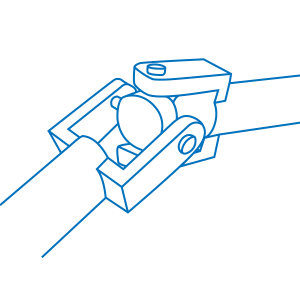
The pin joint is the most common design. It consists of a pin passing through a bush in the coupling rod. It’s simple, effective, and relatively cheap to manufacture.
- Pros: Compact, easy to maintain, and cost-effective for light-to-medium duties.
- Cons: The “pin” takes the load on a very small surface area. Over time, this “point loading” can cause the pin to wear or even shear if the pressure gets too high.
- Best for: Grey water/ light wastewater, low viscosity chemical dosing, and lower-pressure applications.
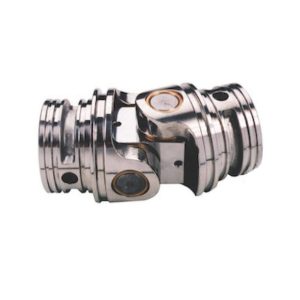
2. The Cardan (Gear) Joint (The Heavy-Lifter)
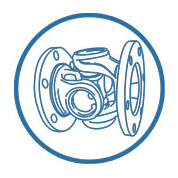
Heavy-duty pumps—like those we often specify at Atlantic Pumps for mining, bioresources or heavy industry—frequently use Cardan-type joints. These are more like the universal joints you’d find on the drivetrain of a 4×4 truck.
- Pros: They distribute the load over a much larger surface area. This reduces wear and allows the pump to handle much higher torque and internal pressures without breaking. They are significantly more robust.
- Cons: Cardan joints are larger, by necessity, so take up more space inside the suction casing of the pump. This can restrict flow through the pump so allowances must be made in pump design to accommodate them.
- Best for: Mining, heavy sludge, high-viscosity pastes, high-head applications where the pump is working against significant resistance.
Who Needs the “Stronger” Joint?
If you are in the quarrying, mining, or heavy recycling industries, you should almost always be looking for Cardan-type joints. When you are pumping abrasive slurry or thick, dewatered sludge, the torque required to move that “plug” of material is immense. A standard pin joint might last a few months, but a Cardan joint is built for years of that level of punishment.
Potential Failures: What Goes Wrong?
Because these joints are hidden inside the pump, they are often “out of sight, out of mind” – until the pump stops turning. Here are the most common issues:
Boot/Sleeve Failure: Both pin and Cardan joints are usually packed with grease and sealed with a protective rubber “boot” or sleeve. If this rubber tears (due to chemical attack or abrasive particles), the grease washes out, and the “liquid sandpaper” you are pumping gets in. Once that happens, the joint can grind itself to pieces within hours.
Fatigue: Constant flexing eventually causes metal fatigue. In high-pressure environments, the coupling rod itself can snap if the pump is repeatedly started and stopped under high head pressure.
Torsional Shock: If the pump is started while the fluid inside has “settled” or hardened, the sudden jerk of torque can shear the pins or snap the joint.
How to Diagnose and Prevent Shaft & Joint Issues
The “Ear” Test: One of the best ways to diagnose a failing joint is by listening. A healthy PCP should have a consistent hum or a rhythmic “whoosh.” If you start hearing a metallic clunking, knocking, or “chattering” sound coming from the suction housing area, your joints are likely worn and have developed too much “play.”
The Visual Inspection: During every maintenance check, look at the joint sleeves. Is there grease leaking out? Is the rubber cracked? Replacing an inexpensive rubber boot today can save you from a costly drivetrain replacement next month.
The Pro-Tip for Longevity: Always use a Variable Speed Drive (VSD) to “soft-start” your pump. This slowly ramps up the torque, protecting the joints and shafts from that initial “hammer blow” of energy that causes most mechanical fractures.
Balanced Mounting: Mount pumps on a stable, level base for optimal lifetime.
Conclusion
The joints and shafts are the unsung heroes of the Progressive Cavity Pump. While the rotor and stator generate the flow, the joints make the motion possible. By choosing the right joint for your industry—and keeping a close eye on those protective rubber boots—you can ensure your pump stays in the pit and out of the workshop.
Atlantic Pumps specialises in long-lasting, low Total Cost of Ownership (TCO) assets in heavy-duty industrial pumping. We often recommend the Toro-Kronoa PC pump for demanding applications, as the entire range uses an advanced double cardan-jointed shaft design as standard. The mechanism is non-welded, allowing for replacement of worn components when needed, and forces are spread over a large contact surface.
Don’t forget to check out other pump training formats and to sign up to our Pump Academy newsletter
Download “What’s wrong with this pump? Pump Health Diagnosis”
Have questions about which progressive cavity pump is right for your process? Contact the technical team at Atlantic Pumps for a practical, no-nonsense assessment of your pump options.
We also take a sustainable approach to our work and are committed to reducing energy waste from pumps. Our expert knowledge allows us to reduce energy usage by 20% on the average site!
Call us today on 0800 118 2500 for more information.