March 24 2026
 3 min read
As the water industry moves through AMP8, the scrutiny on every pound invested has never been higher. While TOTEX provides the flexibility to focus on outcomes, it often masks the specific underlying issues driving costs up. One of the most persistent and misunderstood of these asset-eating, budget-breaking gremlins is grit.
Grit-associated costs are often a large part of TOTEX, so much so that we propose a new term: GRITEX.
When abrasive solids pass through pumps at high velocity, they rapidly scour away vital components and precisely engineered surfaces. As this happens, energy consumption increases and, sooner or later, a costly intervention is required.
Historically, the water industry has become accustomed to seeing pumps as ‘consumables’ and downtime as “inevitable”. This is largely because grit management has traditionally taken a backseat to the urgent requirements of sanitary and biological treatment. However, when we look at comparable situations in the mineral extraction sector, we see that this high “friction tax” is not an inevitability—it’s a procurement choice.
High levels of grit passing through the wrong type of pumps can dramatically increase maintenance frequency and energy burden. Atlantic Pumps has flipped this simply by replacing pumps with one designed and built for grit. With the right pump replacement, it’s not uncommon to see the wear part life extended by 5-6x.
What is GritEx?
By defining GritEx, we move away from treating grit-related maintenance as an “unavoidable BotEx cost” and begin to see it as a variable within our power to manage.
GritEx is the total expenditure (CapEx + OpEx) directly attributable to the presence of abrasive solids in the process stream. It is more than just the cost of a replacement impeller; it is the total lifecycle cost of handling grit.
GritEx includes:
- Accelerated Depreciation (CapEx): The premature failure of pumps, centrifuges, and valves that were designed for soft solids, not sand-blasting media.
- Operational Drag (OpEx): The energy inefficiency of “sweating” worn assets and the heavy labour costs of manually clearing grit-traps, tanks, and aeration basins.
- The Carbon & Financial Burden: Worn pumps must work harder to maintain flow. This quiet growth in energy consumption is often less obvious than a sudden failure, but it is a major drain on Net Zero and WISER goals.
- The “Stokes’ Law” Gap: Fine grit (<150 microns) and FOG-coated particles easily bypass traditional headworks, causing “death by a thousand cuts” to downstream equipment.
The Perfect Sand Particle is a Myth
Conventional grit management is often based on overly simplistic theory. Standard removal efficiency at the headworks assumes all grit is clean, spherical sand. Theoretical models like Stokes’ Law assume a specific gravity (SG) of 2.65 and a particle size of >200 microns.
Field research proves the reality is far more complex:
- Sand/FOG Composites: Grit in combined sewage often gets coated in fats, oils, and grease (FOG). This reduces its effective SG, making it 14%–30% less settleable than predicted. This buoyancy carries abrasive grit deep into the plant.
- Greasy Grit: FOG-coated grit can combine into larger solids post-screening, causing blockages.
- The Size Variance: Grit traps usually target >200 microns. However, 35%–60% of abrasive grit removed from anaerobic digesters is under 150 microns. This fine grit scours high-flow pumps and settles in aeration basins.
- Sharp Geometry: Unlike rounded river sand, wastewater grit often has sharp, hard edges that act like industrial abrasives, scouring pipe and pump surfaces.
Why do pumps wear out so quickly?
Many pumps currently in use at WwTW were originally designed for efficiency in high-volume clean-water service. When these pumps handle abstracted raw water or storm flows with entrained grit, they are prone to premature wear, performance drop-off and rapid failure.
For many pump types, efficiency depends on tight gap tolerances between moving parts. As grit scours these surfaces, water “slips back” (recirculates) within the pump. To maintain the required output, the pump must draw more power, resulting in exponential increases in energy consumption.
Once internal pump wear begins, it can quickly escalate as higher volumes push through the wear gaps.
What can we change for better grit-handling?
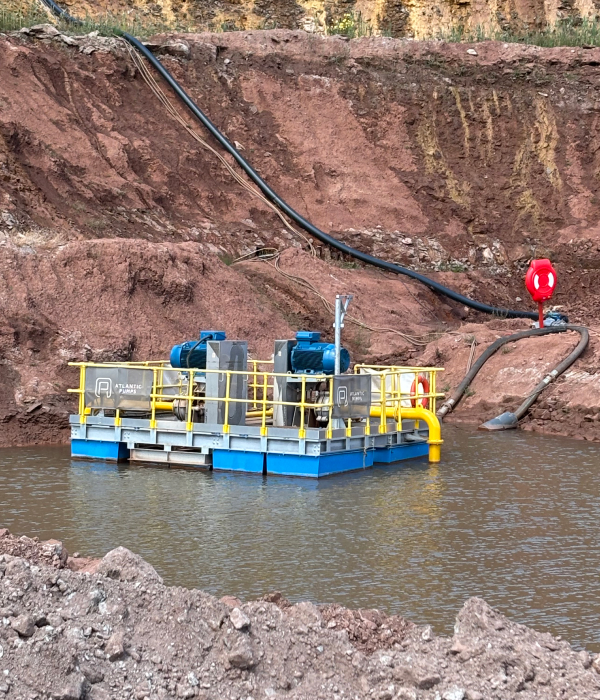
Early-stage grit removal only goes so far. One of the most potent ways to reduce grit’s impact is to choose pumps designed to withstand it. Originally developed for aggregate quarries, such pumps are being used on specific duties in raw water abstraction, desludging, and wastewater handling.
Atlantic Pumps has seen this transition firsthand: by applying mining-grade wear-resistance pumps to wastewater duties, we’ve helped sites move from replacing parts every 3 months to every 2 years. This isn’t just a maintenance win; it’s a massive GritEx reduction that frees up budget for other AMP8 priorities.
Reduce GritEx To Drive Down TOTEX
Grit is a silent thief of capacity and budget. Reducing its impact requires a two-pronged approach: Removal and Resilience.
While biological treatment has historically taken priority, climate and population pressures are now forcing grit management to the fore. This is where we can turn to the mineral extractive industries for a solution. After all, who knows how to handle abrasive solids better than our mining and quarrying peers?
Ready to Tame Your GritEx?
Don’t let “business as usual” drain your AMP8 budget. Atlantic Pumps provides the strategic insights and ready-engineered solutions to turn grit from a budget-breaker into a well-managed variable.
- Strategic Insight: Read our companion piece, “What the Water Industry Can Learn From Quarrying and Mining.”
- Actionable Solutions: Reach out to our Water Asset Team today for a site audit and see how mining-grade pump resilience can slash your GritEx.
We also take a sustainable approach to our work and are committed to reducing energy waste from pumps. Our expert knowledge allows us to reduce energy usage by 20% on the average site!
Call us today on 0800 118 2500 for more information.